Just a quick note to let y'all know that there will be an Urban Ag Fair in JP tomorrow morning at the relatively-new Agricultural Hall, just a few blocks from the Stony Brook T stop!
The fair is from 9am-1pm, and there will be contests for a wide variety of produce, including eggs and pies (NOM), so send in your entry form by 6pm tonight!
I'll be there for a while too... I may even have an egg entered in the contest. :D
Saturday, September 15, 2012

Saturday, September 1, 2012
Look at me! I'm so upset that I'm MOLTING!
So... it's about that time of year when all chickens try to give their owners a minor heart attack.
It might go something like this:
You sleepily wander out to the coop one morning in late summer/early fall, expecting to do your usual check-in/feeding/watering and you open the coop to find feathers EVERYWHERE! You immediately panic and start doing The Count to see who's ok and who got attacked by some vicious creature and find...
Everyone present and accounted for.
Huh?
You count again... and again find everyone to be utterly hale.
(And looking at you very curiously because they're not quite sure why you're freaking out.)
Now that you can breathe normally again, you may notice that all the feathers seem to be from a particular bird or two and, upon closer inspection, you see that they seem to be wearing a lighter-season jacket than usual (they're not quite as thick-and-fluffy).
This, my feather-loving friends, is what's called MOLTING. It happens approximately once a year, when all birds gradually shed their year-old, worn-out feathers and replace them with shiny new ones (check those two links for pics of slightly less-gradual molts). In your typical migratory wild birds, this happens so they have fresh, strong feathers to carry them the thousands of miles they need to travel to get to their wintering grounds. In non-migratory birds, it happens so they have fresh, complete, un-worn feathers to create efficient insulation and keep them warm for the winter. In chickens, it happens so we have a treasure trove of feathers with which to make ART, of course. (Except that many of them will be worn/broken/messy/otherwise unusable, in which case they're just there for the initial scare-factor.)
~~Philosophical interlude~~
Ponder this: in nature, many physical structures are intended to be temporary. Bird nests are only made to last a season, feathers break down over the year and get replaced, plants grow entire structures that only last a few months, we all continuously shed-and-replace hair, skin, the cells in our stomach lining, etc. And all of this "waste" becomes "fuel" or "materials" for something else to eat or use. The cycle of breakdown and regrowth is necessary and efficient. Let the cycle happen and let things go.
~~End philosophical interlude~~
There are other not-so-okay reasons that one of your girls might lose feathers, including external parasites or disease, or if they are getting picked on by other members of the flock. Generally they will lose feathers in a sequence starting with the head and neck, then progressing to sections of the body, and finally ending with the wings and tail. If instead of this pattern you are noticing loss of feathers only around the vent or chin check for lice and mites, if the missing feathers are only on the top of the head/neck check for aggressive flockmates, and if there are any other accompanying symptoms such as lethargy or lack of appetite or a general case of NQR (Not Quite Right) then you likely have an issue that is somewhat unrelated to molting.
In general, you don't need to change anything about your daily routine to accommodate the molting process, but given that they will be putting a lot of their body's resources into growing new feathers they tend to lay less frequently during this time. If you'd like to help support their systems during the process, you can either switch to a higher-protein food, or supplement your regular food with high-protein fats, oils, bugs, etc. in the form of higher-protein commercial feeds, sunflower seeds, mealworms, yogurt, or cooked egg and meats. Here's a great BYC thread with more info on feeding for molting and a brief post (not mine) about the fact that chickens are not vegetarian.
I'll leave you with a not-so-minor aside...
If part of the reason you are keeping or want to keep your own chickens is to do some small part to remove yourself and your family from our current large-scale commercial food system, then GREAT! Kudos.
If you hadn't considered this aspect before, then here's one of a gabillion reasons that growing crops and raising food animals on an industrial scale just isn't working: it is a common practice in the commercial egg production industry to induce forced molting in the entire operation at once by withdrawing food for a week or more.
From the linked article, "Natural molting is stimulated by shortening day lengths combined with stress (of any kind). Before confinement housing with artificial lights were the norm, the fall molt caused a fall scarcity of eggs and high market prices. Farmers attempted to pamper their flocks to prevent the molt as long as possible, to take advantage of the high prices. Modern controlled-environment confinement housing has the opposite problem; the hens are not normally presented with sufficient stress or cues to go into molt on their own. However, after laying continuously for nearly a year, their rate of egg production declines, as does the quality of the eggshell and the egg contents. In addition, the hens are seriously overweight."
So yes, the reasoning for it is understandable, but that's only once you get past the precursor that "modern controlled-environment housing... [doesn't present hens] with sufficient stress or cues to go into molt on their own". In my opinion, THAT's the cause. We've been trying to take the "natural" out of nature so we can control it. Forced molting is simply treating a symptom of the system, when it's the system itself that's flawed.*
(And if this is true for them, can you imagine what our own controlled-environment housing is doing to us? Get outside. Eat seasonally. Move your body. Get dirty.)
Next up... To light or not to light: prep for winter.
*This opinion is addressed in the "Critiques" section of the article, where it says that the practice of controlling the molting process predates the development of an industrial egg production system. Sure, but you're still trying to control a system (nature) that took eons to develop, just so a very few people can produce eggs (that they're barely getting paid for) for everyone else to have every morning without seasonal interruption. The technology is useful and wonderous, but we've swung the pendulum too far.
It might go something like this:
You sleepily wander out to the coop one morning in late summer/early fall, expecting to do your usual check-in/feeding/watering and you open the coop to find feathers EVERYWHERE! You immediately panic and start doing The Count to see who's ok and who got attacked by some vicious creature and find...
Everyone present and accounted for.
Huh?
You count again... and again find everyone to be utterly hale.
(And looking at you very curiously because they're not quite sure why you're freaking out.)
Now that you can breathe normally again, you may notice that all the feathers seem to be from a particular bird or two and, upon closer inspection, you see that they seem to be wearing a lighter-season jacket than usual (they're not quite as thick-and-fluffy).
This, my feather-loving friends, is what's called MOLTING. It happens approximately once a year, when all birds gradually shed their year-old, worn-out feathers and replace them with shiny new ones (check those two links for pics of slightly less-gradual molts). In your typical migratory wild birds, this happens so they have fresh, strong feathers to carry them the thousands of miles they need to travel to get to their wintering grounds. In non-migratory birds, it happens so they have fresh, complete, un-worn feathers to create efficient insulation and keep them warm for the winter. In chickens, it happens so we have a treasure trove of feathers with which to make ART, of course. (Except that many of them will be worn/broken/messy/otherwise unusable, in which case they're just there for the initial scare-factor.)
~~Philosophical interlude~~
Ponder this: in nature, many physical structures are intended to be temporary. Bird nests are only made to last a season, feathers break down over the year and get replaced, plants grow entire structures that only last a few months, we all continuously shed-and-replace hair, skin, the cells in our stomach lining, etc. And all of this "waste" becomes "fuel" or "materials" for something else to eat or use. The cycle of breakdown and regrowth is necessary and efficient. Let the cycle happen and let things go.
~~End philosophical interlude~~
There are other not-so-okay reasons that one of your girls might lose feathers, including external parasites or disease, or if they are getting picked on by other members of the flock. Generally they will lose feathers in a sequence starting with the head and neck, then progressing to sections of the body, and finally ending with the wings and tail. If instead of this pattern you are noticing loss of feathers only around the vent or chin check for lice and mites, if the missing feathers are only on the top of the head/neck check for aggressive flockmates, and if there are any other accompanying symptoms such as lethargy or lack of appetite or a general case of NQR (Not Quite Right) then you likely have an issue that is somewhat unrelated to molting.
In general, you don't need to change anything about your daily routine to accommodate the molting process, but given that they will be putting a lot of their body's resources into growing new feathers they tend to lay less frequently during this time. If you'd like to help support their systems during the process, you can either switch to a higher-protein food, or supplement your regular food with high-protein fats, oils, bugs, etc. in the form of higher-protein commercial feeds, sunflower seeds, mealworms, yogurt, or cooked egg and meats. Here's a great BYC thread with more info on feeding for molting and a brief post (not mine) about the fact that chickens are not vegetarian.
I'll leave you with a not-so-minor aside...
If part of the reason you are keeping or want to keep your own chickens is to do some small part to remove yourself and your family from our current large-scale commercial food system, then GREAT! Kudos.
If you hadn't considered this aspect before, then here's one of a gabillion reasons that growing crops and raising food animals on an industrial scale just isn't working: it is a common practice in the commercial egg production industry to induce forced molting in the entire operation at once by withdrawing food for a week or more.
From the linked article, "Natural molting is stimulated by shortening day lengths combined with stress (of any kind). Before confinement housing with artificial lights were the norm, the fall molt caused a fall scarcity of eggs and high market prices. Farmers attempted to pamper their flocks to prevent the molt as long as possible, to take advantage of the high prices. Modern controlled-environment confinement housing has the opposite problem; the hens are not normally presented with sufficient stress or cues to go into molt on their own. However, after laying continuously for nearly a year, their rate of egg production declines, as does the quality of the eggshell and the egg contents. In addition, the hens are seriously overweight."
So yes, the reasoning for it is understandable, but that's only once you get past the precursor that "modern controlled-environment housing... [doesn't present hens] with sufficient stress or cues to go into molt on their own". In my opinion, THAT's the cause. We've been trying to take the "natural" out of nature so we can control it. Forced molting is simply treating a symptom of the system, when it's the system itself that's flawed.*
(And if this is true for them, can you imagine what our own controlled-environment housing is doing to us? Get outside. Eat seasonally. Move your body. Get dirty.)
Next up... To light or not to light: prep for winter.
*This opinion is addressed in the "Critiques" section of the article, where it says that the practice of controlling the molting process predates the development of an industrial egg production system. Sure, but you're still trying to control a system (nature) that took eons to develop, just so a very few people can produce eggs (that they're barely getting paid for) for everyone else to have every morning without seasonal interruption. The technology is useful and wonderous, but we've swung the pendulum too far.
Wednesday, August 15, 2012
The Chickeness in the news! Again!
I was recently interviewed by Minda Berbeco of Seedstock.com, and her "Chickens in the City" article just came out on Monday, featuring her interview with me, as well as a couple of my pictures. Check it out!
And in case you've missed my previous appearances, here are a few others...
In May of 2011, I was filmed by a crew from Animal Planet's "Pets 101" show for an episode featuring backyard farm animals that aired in November of 2011. I currently have a copy of the episode, but lack the software or skill (or time to obtain either at the moment) to edit out my sections into something I can post on youtube, so if anyone is capable and willing to take on a small video-editing job, please let me know!
Boston's NPR radio station, WBUR, did a piece on urban chickens in July of 2011 (also entitled "Chickens in the City" and also featuring a few of my photos). I was also mentioned in a related post.
On 18 May 2012, Chris Orchard with the Somerville Patch published an article that featured a bit about me after I spoke at a city meeting on the proposed zoning ordinance changes.
There's a post on the Somerville Urban Ag blog about a visit I made with a couple of my Chicken Ambassadors to Somerville City Hall to give an Urban Poultry 101 presentation on 31 May 2012.
And, finally, a loosely-related post describing, among other boxes, the "faux chicken coop/real green roof" digbox I created for Dig Boston. Apparently my Digbox is currently living outside of the Legal Seafoods test kitchen just south of the World Trade Center in downtown Boston, so if you happen to walk by it and notice it needs some water, will you toss a drop or two its direction?
So. Much. Excitement! :D
And in case you've missed my previous appearances, here are a few others...
In May of 2011, I was filmed by a crew from Animal Planet's "Pets 101" show for an episode featuring backyard farm animals that aired in November of 2011. I currently have a copy of the episode, but lack the software or skill (or time to obtain either at the moment) to edit out my sections into something I can post on youtube, so if anyone is capable and willing to take on a small video-editing job, please let me know!
Boston's NPR radio station, WBUR, did a piece on urban chickens in July of 2011 (also entitled "Chickens in the City" and also featuring a few of my photos). I was also mentioned in a related post.
On 18 May 2012, Chris Orchard with the Somerville Patch published an article that featured a bit about me after I spoke at a city meeting on the proposed zoning ordinance changes.
There's a post on the Somerville Urban Ag blog about a visit I made with a couple of my Chicken Ambassadors to Somerville City Hall to give an Urban Poultry 101 presentation on 31 May 2012.
And, finally, a loosely-related post describing, among other boxes, the "faux chicken coop/real green roof" digbox I created for Dig Boston. Apparently my Digbox is currently living outside of the Legal Seafoods test kitchen just south of the World Trade Center in downtown Boston, so if you happen to walk by it and notice it needs some water, will you toss a drop or two its direction?
So. Much. Excitement! :D
 |
| "So then the chicken said to the duck..." |
Monday, August 13, 2012
The Chickeness at Boston Greenfest!!
Breaking news:
The Chickeness will be making an appearance at Boston Greenfest at Boston City Hall Plaza this coming weekend! OMG and also YAY!
This is, I believe, New England's largest green-focused festival, and will feature literally hundreds of vendors, exhibitors, performers, and interactive presentations, and all about being more GREEN!
I'll have a table at the festival with a few of my Chicken Ambassadors all day Friday and Sunday for people to meet in person, AND I'll be giving a "Backyard Birds 101" presentation at some point on one of those days (stay tuned for schedule and table location details).
AND to top it all off, I have a very exciting announcement that I intend to reveal at the festival this weekend, so come say hello and get a sneak preview! :D
The Chickeness will be making an appearance at Boston Greenfest at Boston City Hall Plaza this coming weekend! OMG and also YAY!
This is, I believe, New England's largest green-focused festival, and will feature literally hundreds of vendors, exhibitors, performers, and interactive presentations, and all about being more GREEN!
I'll have a table at the festival with a few of my Chicken Ambassadors all day Friday and Sunday for people to meet in person, AND I'll be giving a "Backyard Birds 101" presentation at some point on one of those days (stay tuned for schedule and table location details).
AND to top it all off, I have a very exciting announcement that I intend to reveal at the festival this weekend, so come say hello and get a sneak preview! :D
Friday, August 10, 2012
How can I make you happy?
There's a song by that name stuck in my head right now (check it out - Will Dailey is AWESOMESAUCE).
But first, a few things:
First: I'm on my way to Boston City Hall to help them figure out how to officially legalize chickens in the City of Boston. YAY!
(I attended an Aldermans' meeting for the City of Somerville on Weds night too - they're nearly ready to accept the ordinance changes that will add some more specific guidelines for our already-legal backyard birds.)
Second: Did y'all know that my flock has a FB page? Check there to get additional tips and tricks, links and info, and the occasional hilarious aside. And if you like what you see, then please "like" what you see. ;)
Third: Just had a phone meeting the other day with Noah of Victory Chicken in New York City (Brooklyn, specifically), who is doing something like what I'm doing for the residents of NYC. If you know folks in that lovely city, they have a resource like me there too!
And now to the big finish: How can I make you happy?
Answer: By helping you get your own flock of chickens, of course! :D
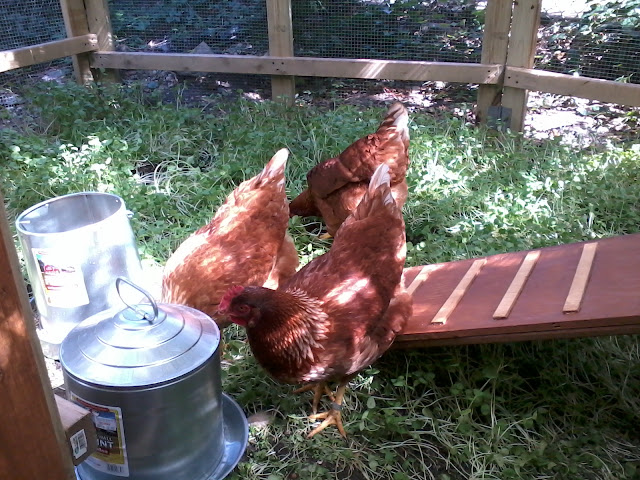
Here are a few pictures of my client Lori S. of Somerville, the GORgeous coop she built with her husband, and her new flock of 4 Star hens I delivered on Wednesday morning - 3 Red Stars and 1 Black Star!


But first, a few things:
First: I'm on my way to Boston City Hall to help them figure out how to officially legalize chickens in the City of Boston. YAY!
(I attended an Aldermans' meeting for the City of Somerville on Weds night too - they're nearly ready to accept the ordinance changes that will add some more specific guidelines for our already-legal backyard birds.)
Second: Did y'all know that my flock has a FB page? Check there to get additional tips and tricks, links and info, and the occasional hilarious aside. And if you like what you see, then please "like" what you see. ;)
Third: Just had a phone meeting the other day with Noah of Victory Chicken in New York City (Brooklyn, specifically), who is doing something like what I'm doing for the residents of NYC. If you know folks in that lovely city, they have a resource like me there too!
And now to the big finish: How can I make you happy?
Answer: By helping you get your own flock of chickens, of course! :D
Here are a few pictures of my client Lori S. of Somerville, the GORgeous coop she built with her husband, and her new flock of 4 Star hens I delivered on Wednesday morning - 3 Red Stars and 1 Black Star!
 |
| Isn't this fantastic?! Lucky, lucky birds. |


Thursday, August 2, 2012
Rent-a-coop, available now!
Feel like you're on the coop fence about whether chickens will actually fit into your daily life?
Oh boy do I have the solution for you...
You can Rent-a-Coop from The Chickeness!
If you live in the greater Boston area, you can rent a complete Chickeness Rent-a-Coop setup for 1 month or 3 months to be sure chicken-keeping will work for you! You know... before committing to the responsibility of a new living creature that can live for 10 years or more...
Rental coops come complete with everything you need, including:
*Coop with run (total footprint is variable, but about 4x8')
*3 laying hens
*bedding and food for the duration of your rental
*daily chicken care training
*monthly maintenance from The Chickeness, if requested (coop cleaning and bird check-up)
*unlimited email assistance from The Chickeness if you have any questions
*unlimited on-site assistance if any birds show signs of illness or injury
Our rental setups are also designed with some permanence in mind - that is, if you completely fall in love with that particular setup and/or those girls, the option to buy the whole setup on a permanent basis is definitely available to you (and most of your rental cost will go towards your purchase).
Rates include the monthly rental rate, delivery, installation, and pickup at the end of your rental period, and a partially-refundable deposit to cover any unexpected injuries to the birds or damages that might occur to the coop structure during your rental (of course I'll teach you everything you need to know to avoid any injury or damages, but things do happen sometimes).
Rates:
All rates include the the entire rental fee for the duration of your contract, plus a refundable $150 deposit and $200 to cover everything associated with delivery and installation, chicken care training, and unlimited email and phone assistance from The Chickeness.
1-month rental with 3 hens - $150/month ($500 total for 1 month)
3-month rental with 3 hens - $125/month ($725 total for 3 months)
Purchase of complete rental setup - $1000 minus whatever you've already paid
If you have any questions (though see the FAQs below), or would like to schedule delivery of your rental coop, send me an email to chat about what you're looking for so we can find the best fit for your space and household, then we'll set up a time for me to come set it all up and show you what you need to know to care for your new girls!
Rental coop FAQs
(for more general info, visit my favorite online resource, BackyardChickens.com):
Q - Will this setup work for the winter too?
A - Yep! All of our coops are designed to be suitable for year-round use, and chickens have their own home-grown down coat that keeps them warm.
Q - Will I still get eggs without a rooster?
A - Definitely! No rooster necessary.
Q - What kind of care do they need?
A - I see it as being pretty similar to a hamster. You need to be sure they have appropriate housing, consistent access to clean water and healthy food, and that everyone is generally happy and healthy. Beyond that, daily check-ins and egg collection takes about 5 minutes, weekly spot cleaning takes about 15 minutes, and monthly changing of bedding takes about 20-30 minutes. Of course, I end up spending hours out there just watching them be the goofy little creatures they are, but that's entirely up to you. ;D
Q - Can I rent for longer than 3 months?
A - Short answer - yes, maybe... let's talk.
A - Longer answer - the point of this program is to give people who are genuinely interested in having their own *permanent* coop a chance to make sure it's the right thing for them and their family, and I feel that 1-3 months is plenty of time to make that decision. I do not intend to rent coops to people with "seasonal" interest, if you know what I mean... These are living animals, and I intend to keep their health and well-being as a top priority, which means ensuring people are serious about caring for them as with any other pet.
Q - Do I need to worry about pests, predators, smell, or noise?
A - If you are responsible about the setup and care of your coop, then not really. Our coops are designed to be large enough for the number of birds we will provide you so they will have plenty of space and will be easy to keep clean. They are also designed to keep out pests and predators, and food will be provided in pest-proof containers - eliminating access to food is the best way to prevent pests and predators from being a problem. As for noise, hens make very little noise, aside from the occasional brawk!-ing that happens when they get excited about something (like if someone lays an egg, if a person walks by, if they find the water... they get excited about a wide variety of things), but overall they're a lot quieter than your typical neighborhood dog.
Have other questions? Send me a note at TheChickeness@gmail.com or check out the info at BackyardChickens.com or MyPetChicken.com!
Oh boy do I have the solution for you...
You can Rent-a-Coop from The Chickeness!
If you live in the greater Boston area, you can rent a complete Chickeness Rent-a-Coop setup for 1 month or 3 months to be sure chicken-keeping will work for you! You know... before committing to the responsibility of a new living creature that can live for 10 years or more...
Rental coops come complete with everything you need, including:
*Coop with run (total footprint is variable, but about 4x8')
*3 laying hens
*bedding and food for the duration of your rental
*daily chicken care training
*monthly maintenance from The Chickeness, if requested (coop cleaning and bird check-up)
*unlimited email assistance from The Chickeness if you have any questions
*unlimited on-site assistance if any birds show signs of illness or injury
Our rental setups are also designed with some permanence in mind - that is, if you completely fall in love with that particular setup and/or those girls, the option to buy the whole setup on a permanent basis is definitely available to you (and most of your rental cost will go towards your purchase).
Rates include the monthly rental rate, delivery, installation, and pickup at the end of your rental period, and a partially-refundable deposit to cover any unexpected injuries to the birds or damages that might occur to the coop structure during your rental (of course I'll teach you everything you need to know to avoid any injury or damages, but things do happen sometimes).
Rates:
All rates include the the entire rental fee for the duration of your contract, plus a refundable $150 deposit and $200 to cover everything associated with delivery and installation, chicken care training, and unlimited email and phone assistance from The Chickeness.
1-month rental with 3 hens - $150/month ($500 total for 1 month)
3-month rental with 3 hens - $125/month ($725 total for 3 months)
Purchase of complete rental setup - $1000 minus whatever you've already paid
If you have any questions (though see the FAQs below), or would like to schedule delivery of your rental coop, send me an email to chat about what you're looking for so we can find the best fit for your space and household, then we'll set up a time for me to come set it all up and show you what you need to know to care for your new girls!
 |
| Here are a couple of my easter egger hens checking out the "Coopette". Your rental coop will have a similar design and appearance, but be just slightly smaller - this one is sized for 4-5 hens. |
Rental coop FAQs
(for more general info, visit my favorite online resource, BackyardChickens.com):
Q - Will this setup work for the winter too?
A - Yep! All of our coops are designed to be suitable for year-round use, and chickens have their own home-grown down coat that keeps them warm.
Q - Will I still get eggs without a rooster?
A - Definitely! No rooster necessary.
Q - What kind of care do they need?
A - I see it as being pretty similar to a hamster. You need to be sure they have appropriate housing, consistent access to clean water and healthy food, and that everyone is generally happy and healthy. Beyond that, daily check-ins and egg collection takes about 5 minutes, weekly spot cleaning takes about 15 minutes, and monthly changing of bedding takes about 20-30 minutes. Of course, I end up spending hours out there just watching them be the goofy little creatures they are, but that's entirely up to you. ;D
Q - Can I rent for longer than 3 months?
A - Short answer - yes, maybe... let's talk.
A - Longer answer - the point of this program is to give people who are genuinely interested in having their own *permanent* coop a chance to make sure it's the right thing for them and their family, and I feel that 1-3 months is plenty of time to make that decision. I do not intend to rent coops to people with "seasonal" interest, if you know what I mean... These are living animals, and I intend to keep their health and well-being as a top priority, which means ensuring people are serious about caring for them as with any other pet.
Q - Do I need to worry about pests, predators, smell, or noise?
A - If you are responsible about the setup and care of your coop, then not really. Our coops are designed to be large enough for the number of birds we will provide you so they will have plenty of space and will be easy to keep clean. They are also designed to keep out pests and predators, and food will be provided in pest-proof containers - eliminating access to food is the best way to prevent pests and predators from being a problem. As for noise, hens make very little noise, aside from the occasional brawk!-ing that happens when they get excited about something (like if someone lays an egg, if a person walks by, if they find the water... they get excited about a wide variety of things), but overall they're a lot quieter than your typical neighborhood dog.
Have other questions? Send me a note at TheChickeness@gmail.com or check out the info at BackyardChickens.com or MyPetChicken.com!
Wednesday, July 25, 2012
*chink chink*... Is this thing on?
Hey folks!
Been a little quiet on the Chickeness front lately, eh? Well never fear! It's been ohsocrazyfullofawesome over here!
Here's a smattering of what I've been up to:
*My ambassadors and I visited a group of kids at the Brown School a few weeks ago as part of their summer program - huge thanks to the Brown School for inviting us, and congrats to them on their fantastic raised bed garden! Check that out on Willow Ave in Somerville, just south of Broadway, and drop me a line if you'd like me to bring a few of my girls to visit your kids' school, playgroup, birthday party, or other event.
*I had my first official individual clients, coordinating the purchase and delivery of some birds for folks here in the city from regional breeders at a big chickenswap in NH a few weeks ago. Congrats to Jim B. of Somerville, and Adriana and Phil H. of Jamaica Plain on the new additions to their family! (Jim and his daughter, Daisy, actually came up to the swap to check it out, too!)
*My model coop, the "Coopette" has been in testing in my yard for a month or so, and my coop-builder and I have been tweaking the design to make it better for you and your flock. Let me know if you'd like a Coopette of your very own, complete with site consultation, delivery and installation, all supplies, and even the chickens too!
*I'm putting together an Indiegogo.com crowdfunding campaign as a way for all of you to support this little slice of the urban ag/localvore movement, helping to *really* get this chicken circus on the road and get some cool swag in return! Rewards will include services, of course, and also t-shirts and other fun "chickenalia", so keep an eye out for that sometime in the next few months.
*I've been working on my website at TheChickeness.com - stay tuned for that to go live very soon!
*My first "Rent-a-Coop" is nearly finished, and ready to be rented out - more on that in an upcoming post, including coop specs and rental rates.
*And finally, I've welcomed a few new additions to my Board of Chicken Ambassadors: say hello to Buttercup, Sweet Pea, and the-Silkie-that-has-yet-to-be-named-but-may-come-to-be-known-as-Wolfgang. :D
That's it for the moment... lots more news and info coming up. Thank you SO much for supporting me and my flock!
Been a little quiet on the Chickeness front lately, eh? Well never fear! It's been ohsocrazyfullofawesome over here!
Here's a smattering of what I've been up to:
*My ambassadors and I visited a group of kids at the Brown School a few weeks ago as part of their summer program - huge thanks to the Brown School for inviting us, and congrats to them on their fantastic raised bed garden! Check that out on Willow Ave in Somerville, just south of Broadway, and drop me a line if you'd like me to bring a few of my girls to visit your kids' school, playgroup, birthday party, or other event.
*I had my first official individual clients, coordinating the purchase and delivery of some birds for folks here in the city from regional breeders at a big chickenswap in NH a few weeks ago. Congrats to Jim B. of Somerville, and Adriana and Phil H. of Jamaica Plain on the new additions to their family! (Jim and his daughter, Daisy, actually came up to the swap to check it out, too!)
*My model coop, the "Coopette" has been in testing in my yard for a month or so, and my coop-builder and I have been tweaking the design to make it better for you and your flock. Let me know if you'd like a Coopette of your very own, complete with site consultation, delivery and installation, all supplies, and even the chickens too!
*I'm putting together an Indiegogo.com crowdfunding campaign as a way for all of you to support this little slice of the urban ag/localvore movement, helping to *really* get this chicken circus on the road and get some cool swag in return! Rewards will include services, of course, and also t-shirts and other fun "chickenalia", so keep an eye out for that sometime in the next few months.
*I've been working on my website at TheChickeness.com - stay tuned for that to go live very soon!
*My first "Rent-a-Coop" is nearly finished, and ready to be rented out - more on that in an upcoming post, including coop specs and rental rates.
*And finally, I've welcomed a few new additions to my Board of Chicken Ambassadors: say hello to Buttercup, Sweet Pea, and the-Silkie-that-has-yet-to-be-named-but-may-come-to-be-known-as-Wolfgang. :D
That's it for the moment... lots more news and info coming up. Thank you SO much for supporting me and my flock!
 |
| Happy customers Adriana and Phil, with two of their four new girls, Richard the Silkie, and a Barred Plymouth Rock. They also got a second Barred Rock and a blue Ameraucana. |
 |
| Miss Fleur checking out the new Coopette. This version is 3x4', has linoleum flooring, a large plexiglass front door, external nest boxes (you can see them in the back), an additional door on the side for cleaning, and an attached 4x6' run with access gates, and can comfortably fit 4 full-grown large fowl hens. |
 |
| Buttercup says Hi. She was helping me type this blog. :D |
 |
| The-Silkie-that-will-likely-be-named-Wolfgang. And the egg she laid for me this morning. NOM. |
Subscribe to:
Posts (Atom)